

What Are You Looking For?
 Whatsapp us

Crosile® 6296 & 6297 — Engineered for Stronger, Simpler Silicone Bonding
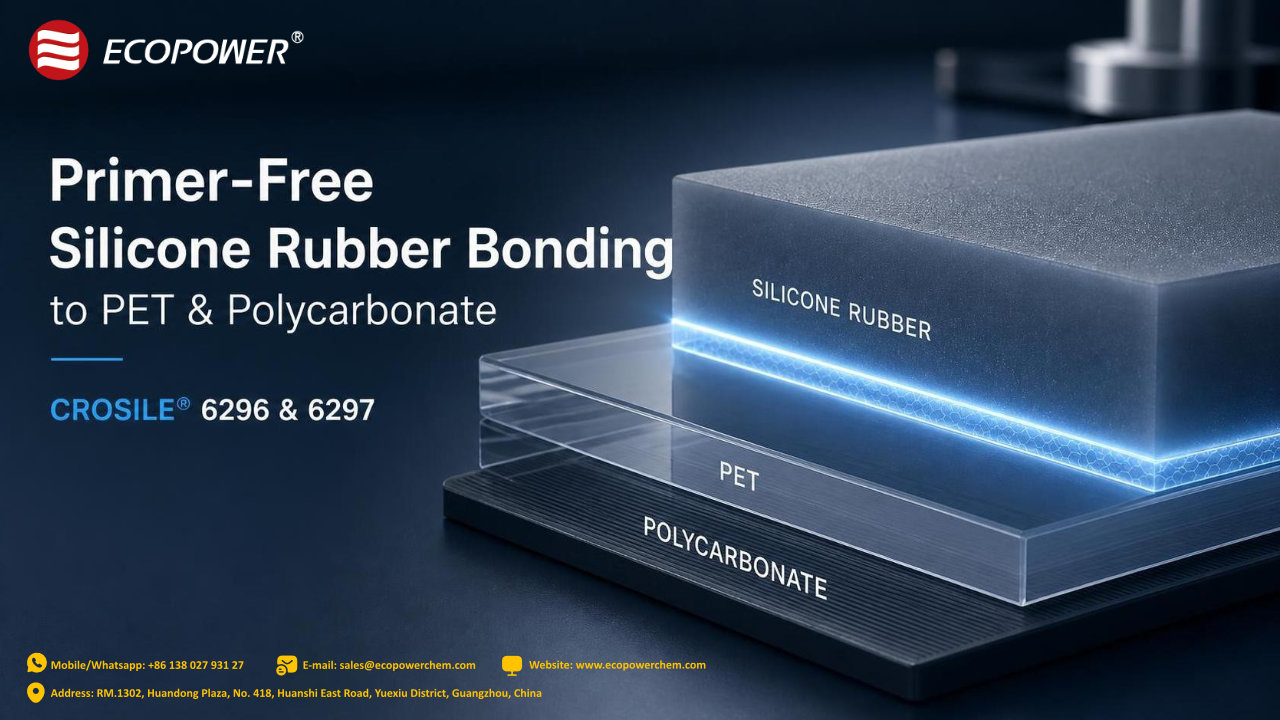
Bonding silicone rubber to polar materials like polycarbonate (PC) and polyester (PET) has long been one of the most demanding challenges in precision manufacturing. Traditional silicone rubber primer solutions add extra steps, increase process complexity, and often deliver inconsistent results.
What if you could skip the primer — and get better adhesion? That's exactly what Crosile® 6296 and 6297 deliver.
Crosile® silicone rubber adhesion promoters are designed to match specific substrates at the molecular level. No more one-size-fits-all compromises. Each Crosile® product is purpose-built for its target substrate.
| Product | Designed For | What Makes It Different |
|---|---|---|
| Crosile® 6296 | PET / Polyester | Epoxy + hydrogen-containing groups penetrate PET surfaces for strong interfacial bonding |
| Crosile® 6297 | PC / Polycarbonate | Epoxy + phenyl groups deliver durable adhesion with superior thermal stability |
| 6296 + 6297 (1:1 mix) | PA / Polyamide | Combined formulation extends bonding capability to polyamide substrates |
When your application requires silicone rubber to PET bonding, Crosile® 6296 delivers.
For demanding polycarbonate bonding applications, Crosile® 6297 is engineered to perform.
Crosile® isn't a primer — it's an adhesion promoter additive that goes directly into your silicone formulation. That means:
| Traditional Primer Process | Crosile® Process |
|---|---|
| Apply primer to substrate | Skip this step |
| Wait for primer to dry | Skip this step |
| Apply silicone | Add Crosile® directly to silicone (0.6%–1.4%) |
| Hope for consistent coverage | Achieve uniform molecular-level bonding |
Worried about catalyst compatibility? Crosile® is designed with that in mind. Both 6296 and 6297 are:
Your process stays clean. Your results stay consistent.
Crosile® doesn't just work in the lab — it performs in the real world.
| Test | Result |
|---|---|
| Temperature resistance | -50°C to 180°C |
| Double 85 aging test (85°C / 85% RH) | Pass — no delamination |
| Hot-humid resistance | No cracking, no yellowing |
| Peel strength improvement | >80% vs. untreated (ASTM D903) |
When your product needs to last, Crosile® delivers the durability you can count on.
Crosile® silicone adhesion promoters serve a wide range of industries:
How do you bond liquid silicone rubber to PET?
Add Crosile® 6296 to your silicone formulation at 0.6%–1.4%. Its epoxy and hydrogen-containing groups create strong chemical bonds with PET surfaces — no separate primer needed.
What's the best adhesion promoter for silicone to polycarbonate?
Crosile® 6297 is specifically designed for PC bonding. Its epoxy and phenyl groups provide excellent adhesion strength and long-term thermal stability.
Can I bond silicone rubber to PA/polyamide?
Yes. Mix Crosile® 6296 and 6297 at a 1:1 ratio to achieve reliable liquid silicone rubber bonding to polyamide substrates.
Will Crosile® work with my platinum-cure silicone?
Yes. Crosile® is amine-free and sulfur-free, so it's fully compatible with platinum catalyst systems. No risk of catalyst poisoning.
How is Crosile® different from silicone primer?
Crosile® is an additive, not a primer. You add it directly to your silicone formulation, eliminating extra application steps while achieving stronger, more consistent bonding.
Our technical team is ready to help you find the right Crosile® solution for your application. Request a sample or schedule a technical consultation today.
Packaging: 1 kg/bottle — flexible quantities for R&D trials through full-scale production.
Note: Performance data is based on laboratory testing. Results may vary based on specific process conditions. Contact us for application-specific guidance.
Leave A Message
Scan to wechat :

Home
Products
contact