Halogen-free flame retardant cables commonly use aluminum trihydroxide (ATH) and magnesium dihydroxide (MDH) as fillers. These inorganic powders have high surface polarity and poor compatibility with polyolefin matrices, leading to agglomeration and reduced mechanical properties and flame retardancy. Silane coupling agents are often employed to address this issue.
ECOPOWER's Crosile®-173 (vinyltriisopropoxysilane) stands out in ultrafine powder treatment and high-end cable compounds due to its unique hydrolysis behavior.
Molecular Structure and Hydrolysis Characteristics
Crosile®-173 contains three isopropoxy groups, which have greater steric hindrance than methoxy (e.g., Crosile®-171) or ethoxy groups (e.g., Crosile®-151). This results in a slower hydrolysis rate in the presence of water. For filler surface treatment, slow hydrolysis offers:
- Longer pot life and reduced risk of premature condensation;
- Sufficient time for silane molecules to uniformly spread on the filler surface, forming a monolayer coating;
- Suitability for high-specific-surface-area ultrafine powders (e.g., MDH with particle size <1 μm), preventing local over-reaction and uneven coverage.
Key Functions in Cable Compounds
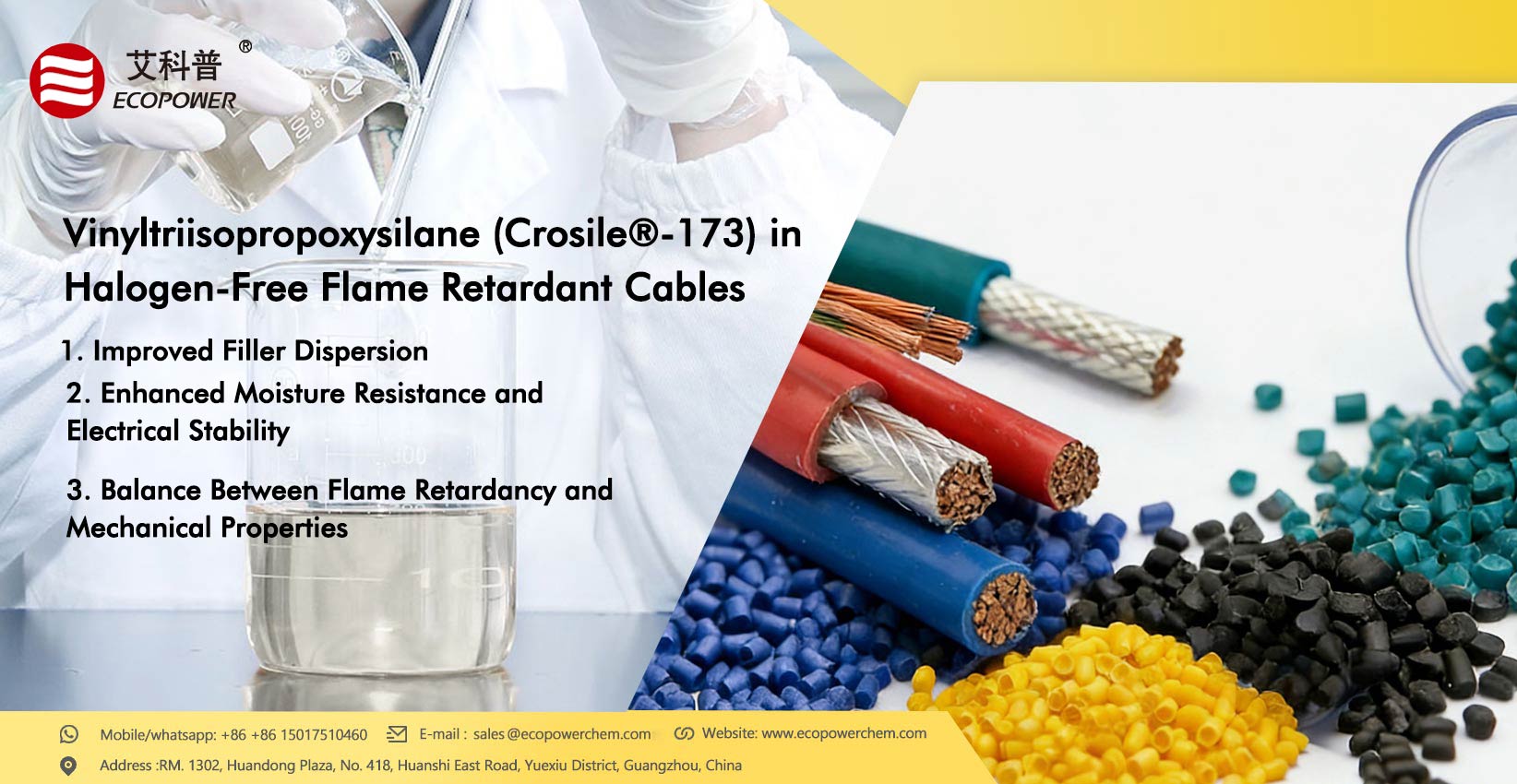
1. Improved Filler Dispersion
After treatment with Crosile®-173, the filler surface becomes hydrophobic, enhancing wettability with the resin. Agglomeration during compounding is reduced, resulting in uniform dispersion, smoother product surfaces, and more stable extrusion.
2. Enhanced Moisture Resistance and Electrical Stability
The silane forms chemical bonds at the filler-resin interface, creating a tight bond. In humid environments, water penetration along the interface is hindered, delaying the decline in insulation resistance. Humidity aging tests show that cables treated with Crosile®-173 maintain higher volume resistivity after prolonged water exposure.
3. Balance Between Flame Retardancy and Mechanical Properties
At high filler loadings, interfacial defects are the main cause of embrittlement. Crosile®-173's coupling action allows the filler to contribute some reinforcement, minimizing loss of tensile strength and elongation at break. Meanwhile, well-dispersed fillers promote the formation of a continuous char layer during combustion, enhancing flame retardancy.
Comparison with Common Vinyl Silanes
| silane type |
Hydrolyzable Group |
Hydrolysis Rate |
Typical Applications |
| Crosile®-151 |
Triethoxy Medium |
Fast |
General fillers, moderate moisture control |
| Crosile®-171 |
Trimethoxy |
Fast |
Systems requiring rapid reaction |
| Crosile®-172 |
Methoxyethoxy |
Medium |
Intermediate between 151 and 173 |
| Crosile®-173 |
Triisopropoxy |
Slow |
Ultrafine fillers, systems demanding uniform |
In ultrafine filler modification, active flame retardant production, or processes requiring longer processing windows, the slow hydrolysis of Crosile®-173 ensures more consistent results.
Application Guidelines
- Direct Addition: Add the silane together with other additives during compounding. Ensure sufficient temperature and moisture (or use a catalyst) to promote reaction.
- Pretreatment: Dilute the silane with an alcohol/water solution (weakly acidic conditions can accelerate hydrolysis). Spray onto the filler under high-speed mixing, then dry. This method is suitable for producing active flame retardant powders.
Extended Applications
Beyond cable materials, Crosile®-173 is also used in:
- Silane-crosslinked polyethylene: as a crosslinker for heat-resistant pipes and wire insulation;
- Silicone-acrylic emulsions: due to its hydrolytic stability, the emulsion system is less prone to gelation, suitable for high-performance exterior coatings.
Vinyltriisopropoxysilane (Crosile®-173) addresses dispersion and interfacial challenges of ultrafine inorganic flame retardant fillers in highly filled systems through its slow, controlled hydrolysis. For high-end cable compounds demanding long-term reliability and processing stability, it is a functional additive worth considering.
 Whatsapp us